Showing posts with label Story of the World. Show all posts

Wednesday, October 23, 2013

A Monk's Supper - Lentil Soup

To finish off our week of studying monks there was a suggestion of preparing a monk's supper. We began by preparing the recommended (and delicious) Lentil Soup. We began by chopping up onions, carrots and celery and then adding garlic, oregano and basil. How beautiful are these veggies?
 After the veggies had cooked for a bit we added lentils, water and crushed tomatoes.
 After letting it simmer for an hour (or more) we added vinegar and spinach along with salt and pepper to taste. This was so delicious!
 We followed the recommendation of adding crusty bread (thank you Trader Joe's), cheddar cheese and sliced apples along with water to drink.
 The kids fixing their plates.


This was such a yummy supper! Tim thought it was too fancy for a monk's dinner. I have to admit it was significantly better than I thought it would be and my kids definitely don't view cheese and apples as a hardship! :) We'll be eating like monk's again in the future for sure! :)

Tuesday, October 22, 2013

Medieval Illuminations

As well as learning how monks copied books we learned how they decorated the books with illuminations. So as another art project during the week the girls designed and completed their own illuminations. We again used the book "Across a Dark and Wild Sea" by Don Brown as well as our coloring pages as inspiration. Both of the girls began by drawing their plan on a regular piece of paper. They then recreated their work on cardstock and we added gold leaf.
 Here are the girl's finished products. Kennedy's is on the left and Reagan's is on the right. Like the monks, we concentrated on using primarily vibrant colors (blue, green, red and yellow) along with the gold leaf to enhance the look of our illuminations.
 Because Reagan didn't follow the directions she became somewhat frustrated with this project and ended up getting quite a bit of assistance from Tim.
~
Kennedy did a fabulous job, however, and really enjoyed the process of design through completion. Kennedy's bird did crack me up a bit though. First of all she drew it entirely by herself which again impressed me. I tried and tried to convince her it would be so pretty to do the entire belly of the bird in gold leaf. She refused insisting it would not be realistic for a robin to have a gold belly. We went back and forth over this throughout the design and up until the end of her completed work. So after she insisted it would NOT be realistic to use gold for a robin's belly she went a colored her robin blue!?!?! What a little goofball! lol :) She definitely gave me a good laugh with her ever so realistic robin, which as you can see does not have an entirely gold belly...

Medieval Writing and Tim's B-Day

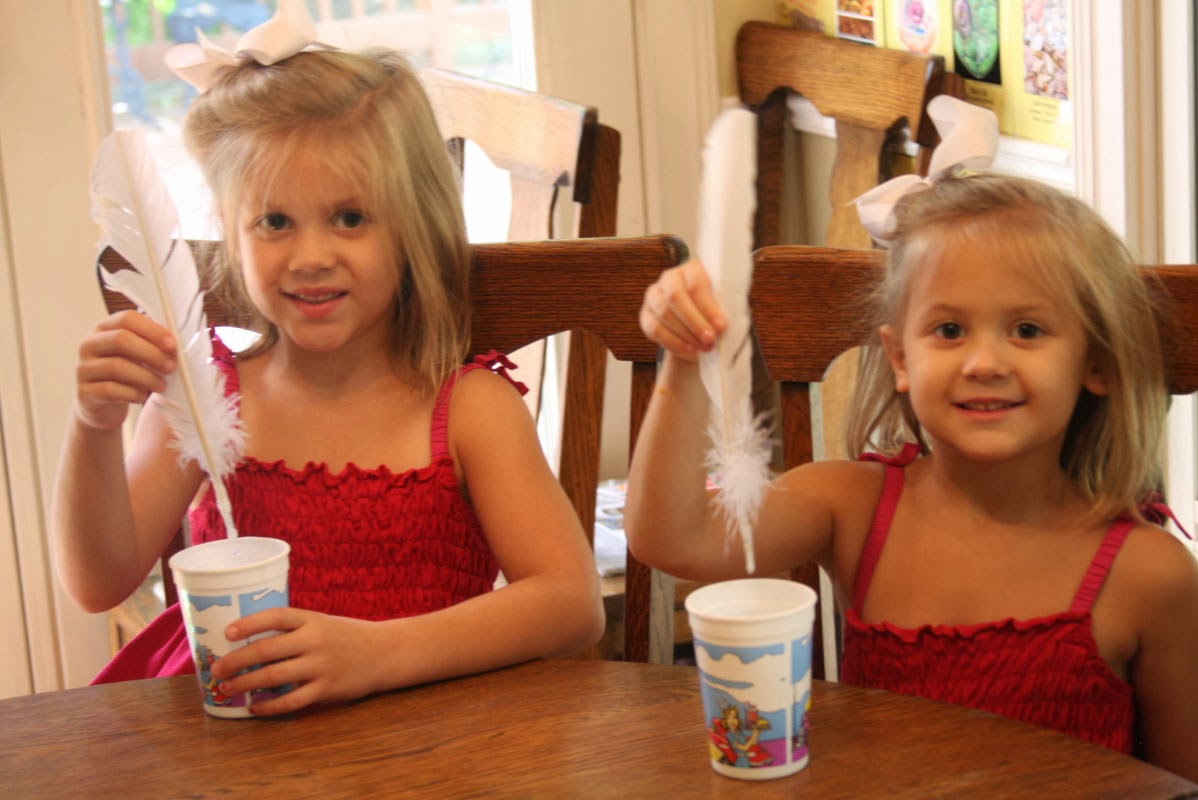
While we have been spending a good deal of time exploring our solar system this Fall we certainly have not been neglecting our Story of the World studies. Our third week of Story of the World was "Christianity Comes to Britain." We learned how the Pope sent Augustine to England and how Augustine became the first Archbishop of Canterbury. We also learned about Medieval Monasteries and how monks painstakingly copied books by hand. We enjoyed the story "Across a Dark and Wild Sea" which is about an Irish monk, Comcille, and how he spent his life as a scribe. As a craft project the girls made and used Quill Pens.
To make quills you begin by placing feathers in warm, soapy water and allowing them to soak for 15 minutes.
After the feathers have finished soaking you removed the first couple of inches of the feather and trim the end of the stalk at an angle. You then clean out any debris (we used a toothpick to do this).

We had been learning about illuminations so as well as the pages of "Across a Dark and Wild Sea" I put out a couple of the girl's coloring pages from the week to look at for ideas of what to write.
We purchased ink from Michael's and used a piece of felt as a blotter to remove excess ink from our quills


As you can see, it was a little bit tricky learning how to control the flow of ink so it appeared evenly. The girls were perhaps not the best at remembering to use the blotter each time they dipped their quills in the ink either... This activity definitely makes me thankful for modern pens!
Notice the dirty finger tips, again I'm thankful for modern writing tools! :)
We're throwing Tim's birthday/kiddo picture in here because the girl's both made cards for him with their quills and ink.

 
This was a neat project. Not the best one we've ever done, but relatively simple and the kids enjoyed the process of both making the quill and using them.

Wednesday, September 25, 2013

The Glory That Was Rome

In August we began "Volume 2: The Middle Ages" (from the fall of Rome to the rise of the Renaissance) from the Story of the World series by Susan Wise Bauer and published by Peace Hill Press. We started by learning more about the Roman Empire. One of the activities I thought was really cute for the week was coloring a picture of a flying carpet and adding the girl's faces. Then we reviewed what we had learned about the Roman Empire (from the end of last year as well) by pretending to fly around Europe and Northern Africa.
 We also made a Roman Legion signum or standard during the week. Each legion in the Roman Army carried its own signum, or standard, into battle. While they began simply over time they became more and more elaborate and important. If the legion's standard was lost during a battle, the entire legion was shamed by being disbanded. Most standards were decorated with gold or silver eagles mounted on the top, ribbons, and metal disks with depictions of fierce animals or the emperor. Reagan decided to use three metal disks which included depictions of the emperor and lions. Kennedy chose two disks for her standard which included bears and spiders. The kids really enjoyed this activity as well as parading around with their standards afterwards. I would definitely recommend this project!
Like last year, I find the reading suggestions provided in the Story of the World Activity Book to be extremely useful. I don't know that I have any strong recommendations from the first week to share, but our favorite was probably "I Wonder Why the Romans Wore Togas and Other Questions About Ancient Rome" by Fiona MacDonald (Kingfisher, 1997).


Monday, June 17, 2013

Making a Roman Mosaic

As part of our Story of the World work we spent a good bit of time studying Rome (Julius Caesar, Cleopatra, Augustus Caesar, Nero, Diocletian). We read about mosaics and one of the recommended art activities was to make our own mosaic.  
 Thank you to Grand-dad for helping us out on this activity!
 Working hard

 The two finished products. We had a cross for Jackson to work on as well but he just wanted to carry the caulk gun around and play with cars. I thought for sure he would be interested in joining us in this activity, but it was probably just as well that he wasn't since the caulk was a little messy.
The girls both enjoyed this activity and it's probably the first art project we've made this year that they were both adamant about keeping and displaying in their rooms. They were both quite proud of their work! Thanks again to Grand-dad for cutting out the crosses and helping us get started with the caulk! :)

Thursday, May 9, 2013

Story of the World - Book Recommendations

In my humble opinion the booklist alone in the Story of the World Activity Guide makes it a worth while investment.When I began recording our homeschool journey on this blog nearly a year ago I was including our favorite books from each week as we went. I'm not going to provide a complete list of books we've enjoyed, but for both my own future reference as well as any of our homeschool friends who look at this blog, I did want to include our favorites from the SOTW recommendations. The books I've chosen to share are those the kids enjoyed the most, did the best job of presenting or demonstrating a concept or culture, and were not books I would have likely come across on my own. I have provided this list in order of preference not subject matter.
~
If I had to recommend one book from this year above all others it would be Solomon and the Ant: And Other Jewish Folktales, by Sheldon Oberman (Boyds Mill Press, 2006). There are 43 short stories in this collection and each one is entertaining as well as teaching a lesson. It's hard to say if the kids or adults enjoyed these folktales more. This is a book we have purchased for our own home library and I've also purchased copies to give to family and friends. Everyone should check this book out (literally) today!

This version of Homer's Illiad is another must have; Black Ships Before Troy: The story of the Illiad, by Rosemary Sutcliff (Laurel Leaf, 2005). Reagan especially loved this book!  While it is a simplified version of the Illiad it is still a longer book. We enjoyed reading this as a family one story/chapter at a time during our nightly storytime before bed. It does a great job of introducing kids to the story of the Illiad, and all its' epic heros. Make sure to get the illustrated version when checking out or purchasing this book.

Another great book that Reagan especially enjoyed is a funny story by the name of Archimedes Takes a Bath, by Joan M. Lexau (Crowell, 1969). The story is about a young boy who is given the task of making sure the great, but absentminded, Archimedes eats and bathes on a semi-regular basis. It is during one of his baths the "Archimedes' principle" is discovered.

Hannibal and His 37 Elephants, by Marilyn Hirseh (Holiday House, 1977) is according to SOTW the only children's picture-book available related to the Punic-Wars. We had to work a little harder to get this book (first and only time I've used interlibrary loans where the book came from out-of-state), but it was well worth it. It was a so interesting reading about Hannibal's journey from Carthage to Rome across the Medditeranean Sea as well as the Alps. Can you imagine that journey with 37 elephants? Can you imagine being a Roman and watching a herd of war elephants descend upon ou in Italy? If this book weren't out of print it would be in our home library too!

The Monkey and the Crocodile: A Jataka Tale from India, by Paul Galdone (Clarion, 1987) would probably be Jackson's top pick and recommendation of the year. We've had to renew this book several times and it is a frequent bedtime favorite. The story is about a tricky crocodile and an even trickier little monkey!
 
Jabuti the Tortoise, by Gerald McDermott (Voyager, 2005) is a South American tale that focuses on how the tortoise's shell came to be cracked. It also discusses the colors and special features of several other animals. Both girls loved this book but this was probably Kennedy's favorite book of the year. Many of the books I've recommended were too long to use in our co-op class, this is one we could use and the other co-op kids requested it in subsequent weeks.

From our study of India I would recommend the book One Grain of Rice by Demi (Scholastic, 1997). The library description is good for this book "A reward of one grain of rice doubles day by day into millions of grains of rice when a selfish raja is outwitted by a clever village girl." Besides being a good story it's a great math story since it shows how quickly numbers multiply!

Roman Myths, by Geraldine McCaughrean, illus Emma Chichester Clark (Margaret K. McElderry, 2000) is a wonderful collection of the most well known Roman Myths. It is a great way to introduce and share Roman Mytholgy with children.

D'Aulaire's Book of Greek Myths, by Edgar Parin d'Aulaire (Bantam Doubleday Dell, 1962) is a wonderful collection of all the best loved Greek Myths. Much like the Roman Myth book, it is a great way to introduce Greek Mytholgy to children as well as share these incredible stories as a family.

The Lost Horse: A Chinese Folktale, by Ed Young (Silver Whistle, 1998). This is an interesting story showing how things we think are unlucky can infact be lucky and vice versa.

Anyone who has looked can tell you there are many books to choose from on Egyptian Gods and Goddesses. We found Egyptian Gods and Goddesses, by Henry Barker (Grossett & Dunlap, 1999) was a clear and concise book that kept the kids attention while still being informative.

"Julius Caesar," from Tales from Shakespeare, by Marcia Williams (Candlewick Press, 2004) is a nice way to begin exploring Shakespeare. The book is laid out in a comic book style. The story is told in modern English while the characters have bubbles above their heads using direct quotes from the play. The stories are also significantly condensed with each only being a few pages long. Like I said, I thought this was a really nice way to begin introducing kids to Shakespeare and his works.

There you have it, our list of favorite books from the year. We hope you enjoy sharing these books with your children and families! We would also be interested in hearing any book recommendations you might have for us. We are a family of readers and we're always looking for a great book to enjoy together!

Wednesday, May 8, 2013

Roman Aqueducts and Roads

As we have studied ancient civilizations of the Fertile Crescent, Egypt, Europe and Asia this school year we have done various projects recommended by our Story of the World Activity guide. Most of the projects aren't quite as big or time consuming as the Chicken Mummy, but they have been great for providing a bit of insight into the ancient world. Many projects have involved recipes, stories, games, clothing, writing and art of ancient civilizations.
~
This spring we have spent a good deal of time studying the Romans. We took advantage of having Daddy home and Grammy and Grand-Dad here for Good Friday to complete a project on how to build a Roman aqueduct and road. We had a good time with these two projects, but I am glad we tackled them with all the extra adult hands!
~
The Romans were the first people to use cement in their building projects and roads. As such, we began by mixing sand dough which served as a homemade cement.  We were able to use it for our "Roman Archway and Aqueduct" as well as our "Roman Road." We began by mixing the ingredients outdoors and then heated it over the stove indoors to complete the mixture.
 
 The Romans built archways as water-conduits to bring water from river and mountain resources into their cities. So once we had mixed the cement we flattened it out and used our archway pattern (provided in the SOTW activity guide) to cut out the arches we needed for our aqueduct system.
  After cutting the arches out, we stood them up and stabalized them before baking and hardening them.

 The archways deposited the water into holding tanks (yogurt cup) and the water was then distrubuted throughout the city in a piping network (straws). Not surprisingly the kids had a great time pouring water in at the top of our aqueduct and watching it flow down into our holding tank and out the straws. This project really brought home to the girls how difficult it would have been to build full scale archways and aqueducts as much time as it took as to build this mini one! 


 While the end product doesn't look quite as cool, I actually thought building the Roman road was an even better demonstration of ancient engineering at work. Roman roads were know for their quality especially in comparison to the roads built by other ancient civilizations. We began building our Roman road by using a styrofoam container which represented a ditch the Romans would have dug to begin their road(s).
 Next the Romans placed a layer of sand in the bottom of the ditch
 Next they placed small rocks, cement and finally large rocks to provide a smooth surface to travel over.
 What was especially interesting about this project was the recommendation to do each layer half as long as the previous one so that at the end you could see all four levels of the road at the same time. This project again really helped the girls understand and remember the process ancient people used to build something we think of as commonplace today. When we discussed Rome several weeks later in our co-op class we took this project in with us and Reagan was easily able to explain the process used by the Romans to build roads to her classmates.
Thank you Grammy, Grand-Dad and Daddy for all your engineering assistance!